If you manage a fleet and you've been thinking about electrification, you've probably heard that funding is out there. Vehicle rebates, charging infrastructure grants, utility incentives — it sounds great in theory. But when you start digging in, it can feel overwhelming pretty fast.
The good news? The programs are real, the money is significant, and fleets of all sizes are successfully accessing it. The even better news? You don't have to figure it out alone. Here's what we've learned from working through these programs with fleets across the country. (For the full picture of what's available by state, our EV charger rebates and incentives resource is a good companion to this guide.)
Before diving into the specifics, watch this webinar recording. AmpUp's John Gilbrook joined Dario Pagani from Autel Energy and Tom Brotherton from CALSTART for a conversation on fleet electrification market trends, incentive programs, and the infrastructure design decisions that set successful deployments apart.
TL;DR: How do fleets actually get funding for EV charging? Most fleets leave money on the table by chasing a single program. The ones who get fully funded map every available source and plan their vehicles and infrastructure together.
- Stack your sources. Vehicle rebates, infrastructure grants, utility programs, and air district funds can often be combined on one project.
- Run both tracks in parallel. Lock in your vehicle plan, but start your site and utility conversations immediately — energization can take two years for heavy-duty.
- Right-size your ask. Leaner, well-documented applications consistently beat inflated ones aiming for the maximum cap.
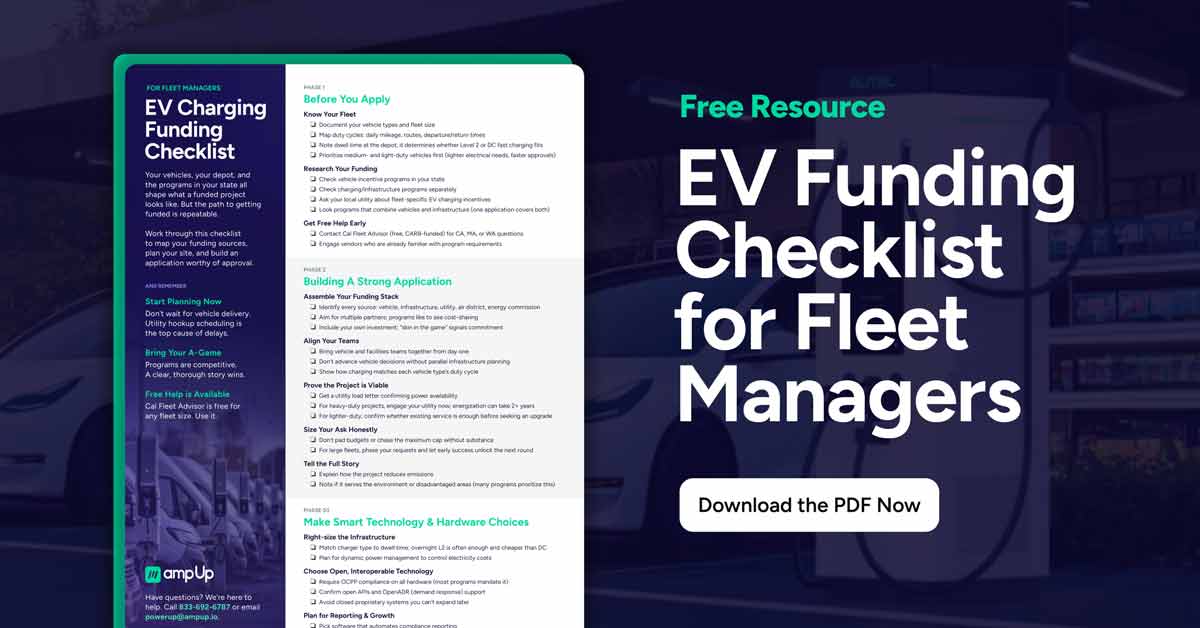
- Use the free help like our EV Charging Funding Checklist for Fleet Managers. Programs like Cal Fleet Advisor (funded by CARB) answer questions for fleets at any stage, at no cost.
The Funding Landscape Is Bigger Than Most People Realize
Most fleet managers know about one or two programs in their state. What many don't realize is that there are often multiple overlapping sources of funding available for a single project, and the fleets that do their homework on this consistently come out ahead.
Take Helix Water District in San Diego as an example. They pulled together $10.2 million in funding from four different partners: the local air district, their utility (SDG&E), the California Energy Commission, and their own $1 million contribution. That's roughly a 10-to-1 return on their own investment, covering nearly 100 vehicles ranging from light-duty to heavy-duty tractors.
That kind of outcome doesn't happen by accident. It happens when a fleet takes the time to map out every available funding source (state vehicle rebates, infrastructure grants, utility programs, air district funds) and builds a strategy around the full picture.
What Fleet Funding Opportunities Are Open Now?
Several major programs are currently accepting applications.If you're in any of these states, there's likely something available to you right now.
- California: HVIP — still open, $213M+ remaining. Plus the new Clean Fuel Rewards program ($250M/year for 4 years).
- Washington: WAZIP — newly launched, with broad medium- and heavy-duty coverage.
- Texas: Funding is available for heavy-duty electric vehicles and chargingequipment.
- Massachusetts: MassEVIP — fleet funding still open (workplace portion paused, fleet active).
- Other active states: Colorado, Maryland, New Jersey, New York, and Oregon.
Start with the Vehicle, But Don't Wait on Infrastructure
The most common starting point for fleets is the vehicle side, and that makes sense. Reducing the upfront cost of an electric vehicle is usually what gets people interested in the first place.
But here's the mistake we see over and over: fleet managers get deep into the vehicle decision before anyone has thought seriously about charging infrastructure. By the time they loop in the facilities team, they're already behind. In some cases, that disconnect has killed projects that had a lot of work already behind them.
The better approach is to run both tracks in parallel. Lock in your vehicle plan, yes, but immediately start asking questions about your site.
Important Questions to Ask About Your Site
- How much power do you have available today?
- What's your utility's timeline for a service upgrade if you need one? For heavy-duty vehicles, that energization process can take two years or more.
- Does the charging setup actually match how your vehicles operate day-to-day?
You don't want to take delivery of a truck and have nowhere to charge it. For most medium- and light-duty fleets, the electrical requirements are much more manageable. In many cases, overnight Level 2 charging is all you need, and you may not need a service upgrade at all. That's worth knowing early: it makes your project simpler, faster to approve, and often more cost-effective. (Not sure where your site stands? A site assessment is a low-lift way to find out. (Also download our EV Charging Funding Checklist for Fleet Managers.)
How to Make Your Application Stand Out
As these programs have grown more popular, they've also gotten more competitive. The bar for approval is higher than it used to be. Here's what tends to separate funded projects from the ones that don't make it through.
The strongest applications show that the fleet has thought through both sides of the project (vehicles and infrastructure) and that the plan is realistic, not just optimistic. That means having a utility assessment in hand, understanding your fleet vehicles' duty cycles, and being clear about how the charging setup matches how those vehicles operate.
It also means being honest about the scale of your ask. Applications that shoot for the maximum funding cap without a solid plan to back it up tend to struggle. Leaner, well-documented projects consistently outperform inflated ones.
You Don’t Have to Find EV Fleet Funding Alone
CalSTART runs a free service called Cal Fleet Advisor, funded by CARB, that answers questions for fleets at any stage — whether you're just getting started or working through a specific challenge. Similar services exist in Washington and Massachusetts. These are genuinely useful resources, especially for smaller fleets that don't have a dedicated team to navigate all of this.
On the vendor side, charge management providers and charging hardware companies that regularly work with these programs can be valuable partners too. They know what programs require, what reviewers look for, and where applications tend to fall apart. (At AmpUp, helping fleets navigate incentives is part of how we work. We're approved for 50+ rebate and incentive programs across North America.)
The path to funded EV fleet charging is navigable. It just takes starting early, planning both sides of the equation, and putting together an application that shows you've done the work.
Want a step-by-step breakdown? Download our EV Charging Funding Checklist for Fleet Managers, or reach out to our team to talk through your project.
EV Fleet Incentive FAQs
How much funding can a fleet actually get for EV charging?
It varies widely by project and location, but the totals can be substantial when sources are combined. One San Diego water district stacked $10.2 million across four partners to electrify nearly 100 vehicles, roughly a 10-to-1 return on its own contribution. The key is mapping every available source rather than relying on a single program.
Can I combine multiple EV charging funding programs?
Yes, and the fleets that come out ahead almost always do. A single project can often draw from state vehicle rebates, infrastructure grants, utility programs, and air district funds at the same time. Mapping the full picture before you apply is what makes stacking possible.
How long does it take to get my fleet site ready to charge?
It depends on your vehicles and your existing electrical capacity. Most medium- and light-duty fleets can run on overnight Level 2 charging and may not need a service upgrade at all. Heavy-duty fleets are a different story: if a utility service upgrade is required, that energization process can take two years or more, which is why you shouldn't wait to start the conversation.
Is there free help for navigating EV fleet funding?
Yes. CalSTART runs Cal Fleet Advisor, a free service funded by CARB that answers questions for fleets at any stage. Similar services exist in Washington and Massachusetts. These are especially valuable for smaller fleets without a dedicated team. Charge management and hardware partners who work with these programs regularly can also help you avoid the pitfalls that sink applications.
What makes an EV charging grant application more likely to be approved?
Reviewers reward realistic, well-documented plans that account for both vehicles and infrastructure: a utility assessment in hand, a clear understanding of duty cycles, and a right-sized funding request rather than a reach for the maximum cap. If your project serves communities historically affected by diesel pollution, say so clearly. For large fleets, phasing your requests and building a track record strengthens future applications.
Ready to take the next step? Download our EV Charging Funding Checklist for Fleet Managers,then schedule a time to connect with us and see firsthand how AmpUp can help secure funding for your fleet project.