Installing EV chargers at a commercial depot isn't the finish line. It's the starting gun. For fleet managers, transportation directors, and operations teams, the real work begins once the chargers are energized: building the systems, schedules, and monitoring workflows that keep every vehicle charged, every shift, every day. Unlike workplace or retail charging, fleet charging is mission-critical: a missed charge isn't an inconvenience, it's a service disruption.
This guide covers the core practices that separate high-performing fleet charging operations from costly, low-uptime ones. We'll address infrastructure planning, load management, telematics integration, driver protocols, and the operational discipline that drives 98.5%+ session success. And remember: no two depots are identical. AmpUp's fleet charging solutions are designed to adapt to your fleet's specific size, duty cycles, and infrastructure constraints.
Ready to explore what fleet charging could look like at your depot? Request a demo.
TL;DR: What Are the Best Practices for Fleet Charging Management?
Successful fleet charging management requires a strategic approach across five core operational areas:
- Right-size your infrastructure: Deploy 1 charger per 2–3 vehicles for most depot operations, using overnight Level 2 charging (7–19 kW) as the foundation, and reserve DC fast charging for opportunity charging or high-utilization vehicles.
- Implement smart load management: Use intelligent power distribution to prevent peak demand charges (which can represent 30–50% of your monthly electricity bill) and automatically balance charging loads based on departure schedules and state-of-charge.
- Integrate with fleet management systems: Connect your charging management platform with telematics providers like Geotab and Samsara to automate vehicle-to-charger assignment, monitor real-time readiness, and maintain 98.5%+ session success rates.
- Establish driver protocols and training: Create clear procedures for connection, troubleshooting, and priority charging. Consistent driver training helps reduce charging errors, improve compliance, and ensure vehicles are ready when needed.
- Monitor KPIs and optimize continuously: Track utilization rates, energy cost per mile, session success rates, and vehicle readiness scores to identify inefficiencies before they become downtime events.
Understanding the Fundamentals of Fleet Charging Operations
Depot Charging vs. Public Charging: Why Return-to-Base Is Critical
For most commercial fleets, public charging is a fallback, not a strategy. Depot charging gives fleet operators control that public infrastructure simply can't match: predictable costs, guaranteed availability during overnight windows, integrated monitoring, and the ability to schedule charging around shift patterns and departure times.
The economics reinforce the operational argument. Public DC fast charging typically costs $0.30–$0.50/kWh or more, compared to $0.10–$0.20/kWh for well-managed depot charging with time-of-use rate optimization. Across a fleet of even 20 vehicles, that difference compounds fast.
Return-to-base charging also enables load management at scale: the single most powerful lever for controlling fleet electricity costs. That's only possible when charging happens on infrastructure you own and control.
Key Differences Between Fleet and Consumer Charging
Fleet charging operates under fundamentally different constraints than consumer or workplace charging. The key differences to plan for:
- Higher utilization: Fleet charging targets 2–3 vehicles per charger with smart scheduling, versus a typical 1:1 consumer ratio.
- Predictable schedules: Known route patterns and return times make optimization possible in ways that public or workplace charging can't support.
- Mission-critical uptime: A failed charge in a consumer context is inconvenient. In a fleet context, it can mean a missed route, a service failure, or a contract penalty. Target 99.9% infrastructure uptime and 98.5%+ session success rates.
- Systems integration requirements: Fleet charging platforms need to connect with dispatch, telematics, and maintenance systems, not just manage individual sessions.
The Business Case: TCO and ROI for Fleet Charging Infrastructure
The numbers support investment. Here's a realistic baseline for a commercial light-duty fleet:
- Infrastructure investment: $3,000–$7,000 per Level 2 port installed, including equipment and electrical work
- Fuel cost savings: 60–80% reduction compared to gasoline or diesel per mile (U.S. Department of Energy)
- Maintenance cost reduction: 25–40% lower than comparable ICE vehicles over the asset's life
- Break-even timeline: 3–6 years for most commercial fleets, faster when incentives and demand charge savings are factored in
Use the AmpUp fleet charging ROI calculator to model your specific situation with your utility rates, vehicle mix, and daily mileage.
Best Practice #1 — Strategic Charging Infrastructure Planning
Calculating Your Charger-to-Vehicle Ratio
Charger-to-vehicle ratio is one of the most consequential planning decisions you'll make, and it's one most fleets get wrong by over-building early or under-building at the point of expansion.
Practical benchmarks by use case:
- High-utilization or multi-shift fleets: 1 charger per 1.5–2 vehicles
- Single-shift operations with long dwell times: 1 charger per 3–4 vehicles
- Standard overnight depot: 1 charger per 2–3 vehicles
These ratios assume smart charging software that staggers sessions and prioritizes vehicles by next-day departure. Without load management, you'll need closer to 1:1 ratios (and significantly more electrical capacity).
Level 2 vs. DC Fast Charging for Fleet Applications
The right answer depends on dwell time and duty cycle, not charging speed:
- Level 2 (7–19 kW): The right choice for overnight depot charging where vehicles have 8+ hours off-route. Cost-effective at $3,000–$7,000 per port and compatible with most commercial electrical infrastructure.
- DC fast charging (50–150 kW): Best for opportunity charging, vehicles returning mid-shift, or high-mileage routes where overnight charging can't fully replenish the battery. Cost is significantly higher at $40,000–$80,000+ per dispenser.
For most depot fleets, a Level 2–primary infrastructure with targeted DCFC for specific vehicles or use cases is the most cost-efficient path.
Electrical Capacity Assessment and Utility Coordination
Start the utility conversation before you finalize your infrastructure plan, not after. Utility timelines for service upgrades are the single most common source of project delays, ranging from 3 months for simple service additions to 18+ months for new transformer installations.
- Conduct a site load assessment and determine available headroom
- Analyze your utility's rate structure, including demand charges and time-of-use options
- Apply for any applicable make-ready or EV fleet programs early — utility incentives can offset 30–70% of infrastructure costs in participating territories
- Size conduit for future expansion, not just current needs; retrofitting costs 2–3x more
Future-Proofing for Fleet Growth
Infrastructure installed for today's fleet size needs to support tomorrow's. Plan for 2–3x charging capacity over a five-year horizon by:
- Installing conduit runs and panel capacity beyond immediate needs
- Specifying OCPP-compliant hardware to preserve flexibility as software platforms and charging technology evolve
- Designing parking layout for pull-through vehicle flow that minimizes congestion during shift changes
- Verifying ADA compliance for mixed-use facilities before construction begins
Best Practice #2:Implementing Smart Load Management
Understanding Demand Charges and Why They Matter
Demand charges are billed based on your peak 15-minute power draw in a billing period — and for fleets without load management, that peak almost always occurs when every vehicle returns to the depot and plugs in simultaneously.
The math is painful: a 500 kW demand peak at $15/kW adds $7,500 to that month's electricity bill — and that's before a single kWh of energy cost. Annually, demand charges can represent $50,000–$150,000 in electricity overhead for medium-sized fleets. Smart charging management that staggers loads and shifts charging to off-peak hours can reduce total electricity costs by up to 40%.
Load Management Strategies to Minimize Peak Demand
Effective load management is a combination of hardware design, software intelligence, and operational discipline:
- Dynamic power allocation: Distribute a site-level power cap intelligently across active charging sessions
- Real-time monitoring and automatic adjustment: Load limits that can't respond to real-time conditions aren't actually load management
AmpUp's charging management platform supports these strategies natively, with load management features that align with how sites bill, authorize users, and report energy.
Time-of-Use Rate Optimization
Off-peak electricity rates — typically 10 PM to 6 AM — can be 20–40% lower than peak-period rates depending on your utility. Shifting the majority of fleet charging to this window is straightforward when you have departure schedules loaded into your charging platform. It's also a meaningful contributor to the overall fleet TCO case.
For fleets in utility territories with demand response programs, participating can generate additional recurring revenue — essentially being paid to shift charging loads when the grid needs flexibility. The California Public Advocates Office reported in 2025 that shifting peak EV load could save between $5 billion and $18 billion in distribution costs by 2040, which is why utilities are increasingly willing to pay for that flexibility.
Best Practice #3: Integration with Fleet Management Systems
Connecting Charging and Telematics Platforms
Your charging platform should know what your telematics platform knows: where each vehicle is, what its state of charge is, and when it's expected to return and depart. When these systems share data, the operational benefits compound:
- Automatic vehicle identification when a driver plugs in
- Real-time state-of-charge sync across the depot dashboard
- Departure readiness alerts before shift starts
- Automated priority charging for vehicles with early next-day dispatch
AmpUp integrates with leading fleet management systems including Geotab and OEM vehicle telematics, enabling unified visibility across your charging and vehicle operations, without adding another siloed tool.
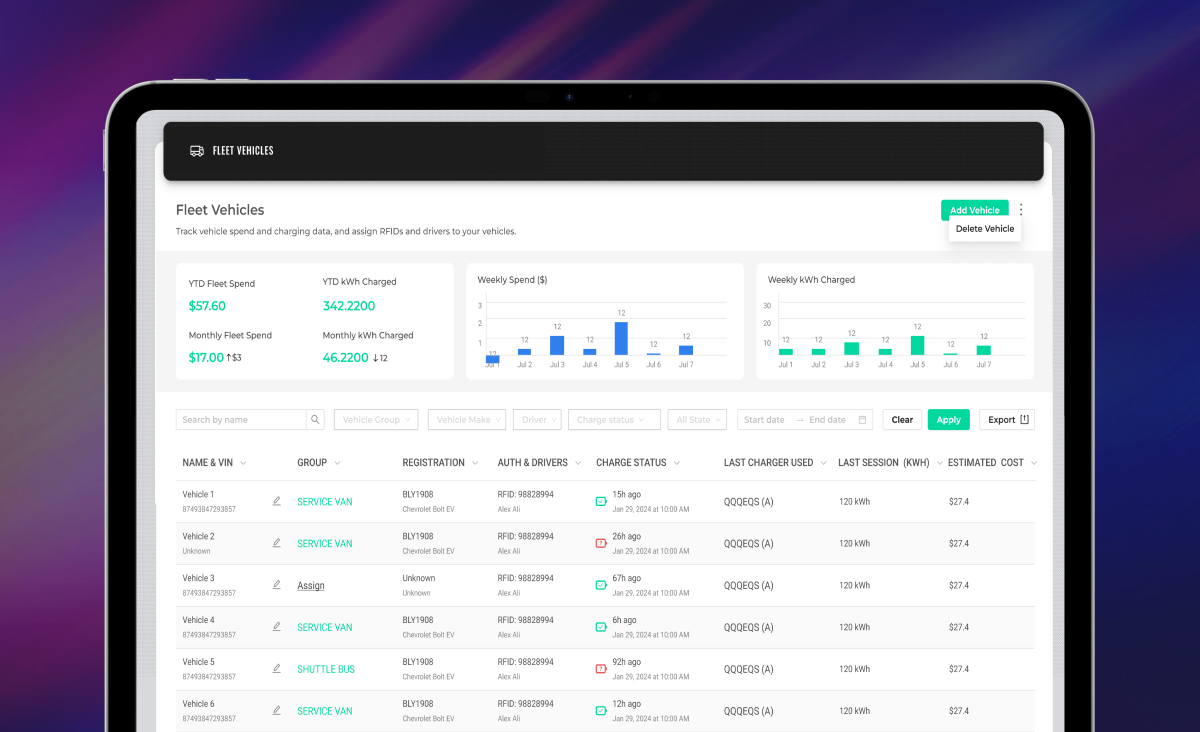
Real-Time Visibility and Fleet Readiness Monitoring
The operational goal isn't 100% charge on every vehicle every morning. It's having every vehicle at the minimum state of charge required for its scheduled route, on time, every shift. That's a subtly different target — and it requires real-time visibility, not just overnight charging.
A well-configured fleet charging dashboard shows:
- Charging status per vehicle (charging, complete, not connected, fault)
- State of charge vs. departure time for every vehicle in the queue
- Alert workflow for sessions that fail or fall behind schedule
- Energy consumption and cost per vehicle, route, and depot
Target: 98.5%+ session success rates, measured as the percentage of initiated charging sessions completed.
Best Practice #4: Establishing Charging Protocols and Driver Training
Standard Operating Procedures for Fleet Drivers
Every fleet should have a written charging SOP. It doesn't need to be long, but it needs to be clear and consistently followed. Minimum contents:
- Plug-in sequence and connection verification (a session that doesn't start is a missed charge)
- Cable handling, storage, and return to cradle
- What to do if the session doesn't initiate (two-step driver troubleshooting before escalation)
- Who to contact and how for active charging faults, especially during off-hours
- Documentation requirements for charging issues
Well-documented protocols and consistent enforcement have been shown to reduce operator error by 60–70% compared to informal charging practices.
Change Management for Fleet Electrification
The operational shift from fill-up-and-go to plug-in-and-schedule is real, and underestimating it is a common mistake. Drivers who are skeptical or unclear on process will find shortcuts. And those shortcuts in charging (skipped plug-ins, ignored alerts) become operational failures.
Invest in the soft side:
- Hands-on equipment training during onboarding, not just slide decks
- Visible win-sharing: actual fuel savings, avoided maintenance, session success data
- Clear escalation channels so drivers don't improvise when something doesn't work
- Fleet champion roles for early adopters who can peer-coach others
The North American Council for Freight Efficiency (NACFE) has documented consistently that driver acceptance and operational discipline are among the most reliable predictors of fleet electrification success, not just vehicle range or charging speed.
Best Practice #5:Maintenance and Reliability Management
Preventive Maintenance Schedules for Charging Infrastructure
Charging infrastructure is a connected electrical asset, not a set-and-forget installation. A baseline preventive maintenance cadence for commercial fleet depots:
- Quarterly: Visual inspection of cables, connectors, mounting hardware, and signage; review session logs for anomalies
- Semi-annual: Test protective devices (GFCI, breakers); verify terminations on accessible connections; check enclosure sealing on outdoor units
- Annual: Full system test, firmware and software review, weather-seal inspection, cable condition assessment
The goal is catching degradation early — a failing connector or a nuisance breaker trip is a small maintenance item until it causes a missed charge on your highest-utilization vehicle.
Achieving 98.5%+ Charging Session Success Rates
Session success rates are the operational KPI that matters most for fleet charging. Here's what high-performing fleets do differently:
- Monitor proactively, not reactively: Real-time alerting on session failures, not next-morning reports
- Define a response workflow: Remote triage first, truck roll only when required; most issues are resolvable remotely
- Track root causes across sites: Pattern recognition across the fleet catches equipment issues before they scale
- Maintain a backup charging strategy: For critical-priority vehicles, know in advance what the contingency is if their primary charger is down
AmpUp's platform delivers 98.5% charging session success — compared to industry averages of 64–80% — because monitoring, alerting, and remote resolution are built into the core product, not bolted on.
24/7 Support and Issue Escalation
Define escalation paths before you need them. At minimum:
- Level 1 (driver self-service): Simple reconnection, power cycle, app check
- Level 2 (dispatcher): Session restart via platform, charger reboot, fleet manager alert
- Level 3 (technical support): Remote diagnostics, firmware check, hardware escalation to service channel
For commercial fleet depots, 24/7 technical support access isn't a nice-to-have. A charging fault that occurs at 2 AM before a 5 AM dispatch needs a resolution path that doesn't require waiting for business hours.
Best Practice #6: Cost Management and Financial Optimization
Tracking Total Cost of Ownership Metrics
Fleet charging decisions that don't model TCO accurately are guesses, not plans. A complete cost picture includes:
- Energy costs: Per kWh, per mile, per vehicle — tracked separately from building energy
- Demand charges: Monthly tracking and trend analysis against load management thresholds
- Infrastructure costs: Amortized across the equipment's useful life (typically 10–15 years)
- Maintenance costs: Charging hardware, electrical components, and software subscriptions combined
- ICE baseline comparison: Ongoing fuel and maintenance costs vs. the electric equivalent
Maximizing Incentives and Grant Funding
The incentive landscape in 2026 has shifted, but significant programs remain active:
- State programs: California's HVIP, New York's Charge Ready, Colorado's Charge Ahead, and others continue to provide tiered incentives for fleet and depot charging. See AmpUp's installation incentives and rebates page for current programs by jurisdiction.
- Utility make-ready programs: Often the largest single incentive available, covering infrastructure costs from the transformer to the charger stub-out. Bake utility discovery into Phase 1 planning — eligibility windows close.
- Low Carbon Fuel Standard (LCFS) credits: Available in California and other participating states; can generate ongoing recurring value from electrified fleet operations.
- EPA Clean School Bus Program and FHWA NEVI funding: For qualifying municipal, transit, and school fleet applications.
Best Practice #7: Performance Monitoring and Continuous Improvement
Key Performance Indicators for Fleet Charging
The KPIs that matter most for mature fleet charging operations:
- Charging session success rate: 98.5%+
- Infrastructure uptime: 99.9%
- Vehicle readiness at shift start: 95%+
- Energy cost per mile (vs. ICE baseline): Track monthly
- Charger utilization rate: 60–80% optimal
- Demand charge as % of electricity bill: Below 25% with load management
Data-Driven Optimization Strategies
Once you have three to six months of operational data, patterns emerge that allow genuine optimization:
- Underutilized chargers: Candidates for reallocation to higher-demand zones or shifts
- Peak demand patterns: Identify which vehicles consistently trigger high-draw events and adjust scheduling
- Battery cycling equity: Rotate vehicles across charger positions to equalize battery cycle counts and protect asset longevity
- Schedule refinement: Compare departure readiness data against actual departure times; adjust charging windows accordingly
Reporting for Stakeholders and Leadership
Fleet charging data is sustainability data, financial data, and operational data simultaneously. Build reporting that serves each audience:
- Executive dashboards: TCO vs. ICE baseline, energy spend, emissions avoided, ESG progress
- Operational reports: Daily readiness summary, session faults, maintenance actions
- Financial reports: Energy costs, demand charges, incentive capture
- Board or investor presentations: Fleet electrification milestone tracking and strategic ROI
Fleet-Specific Use Cases and Considerations
Delivery and Last-Mile Fleets
High daily mileage and predictable routes make last-mile delivery one of the strongest use cases for fleet electrification — and one of the most demanding for charging infrastructure. Key considerations: multi-shift operations requiring opportunity charging mid-day, peak season surge planning (holiday delivery volume can spike vehicle requirements 30–40%), and precise route-to-vehicle matching based on real-time SOC at dispatch.

Service and Utility Fleets
Variable daily usage patterns, emergency response requirements, and integration with work order and dispatch systems define service fleet charging needs. Backup power considerations and guaranteed vehicle availability for critical-response scenarios require more conservative charger-to-vehicle ratios and stricter monitoring thresholds.
Municipal and Government Fleets
As of 2025, 33 U.S. states have set policies to transition government-owned fleets to zero-emission vehicles through mandates or executive orders. Grant funding availability, public accountability for uptime, and diverse vehicle types (sedans, trucks, transit) make municipal fleet charging particularly dependent on platform flexibility and strong reporting capabilities.
School Bus and Transit Fleets
Predictable schedules and overnight depot charging make school bus and transit electrification operationally straightforward once infrastructure is in place. The business case requires a strong upfront cost model; the EPA Clean School Bus Program continues to provide meaningful grant support for qualifying districts. Student safety and service reliability are non-negotiable, which makes session success rates and maintenance discipline especially critical.
Scaling Your Fleet Charging Operations
Pilot Programs: Starting Small and Learning Fast
A 5–10 vehicle pilot over 6–12 months produces the operational data you need to plan full deployment intelligently: actual charging patterns, actual energy costs, actual maintenance events, and actual driver behavior. Define go/no-go criteria before the pilot starts, not after it ends.
Phased Expansion Strategy
Most successful fleet electrification programs follow a three-phase arc:
- Phase 1: Early adopters and optimal use cases (vehicles under 100 miles/day, overnight depot dwell times, predictable routes)
- Phase 2: Mainstream adoption with scaled infrastructure and proven operational playbook
- Phase 3: Full fleet commitment, ICE retirement planning, advanced optimization (V2G, megawatt charging for heavy-duty)
If you’re starting from Phase 1, three to seven years is a realistic timeline for complete fleet transition, though it can be much shorter for smaller fleets or those with favorable infrastructure and utility access.
Managed Fleet Charging Services: The Hands-Off Alternative
For fleet operators who want performance guarantees without building internal charging operations expertise, AmpUp's managed charging services provide 24/7 monitoring, proactive issue resolution, driver and dispatcher support, load management optimization, and regular reporting so your team can focus on running the fleet, not troubleshooting chargers.
Managed services make particular sense when: internal IT or facilities resources are constrained, rapid deployment is required, or a performance SLA (99.9% uptime, 98.5% session success) is a contractual or operational requirement.
Common Fleet Charging Management FAQs
Q: What is the optimal charger-to-vehicle ratio for a fleet depot?
For standard overnight depot operations, 1 charger per 2–3 vehicles is the baseline. With smart load management and departure-time-based scheduling, some fleets achieve 1:3 or better. High-utilization or multi-shift fleets may need 1:1.5 or even 1:1 for critical vehicles. The right number depends on your daily mileage, dwell time, and departure schedule, not a generic benchmark.
Q: How much can smart load management reduce fleet electricity costs?
Consistently 20–40% on total electricity costs when implemented correctly, primarily by shifting charging to off-peak rate windows and flattening demand charge exposure. Demand charges alone can represent 30–50% of a fleet's monthly electricity bill without load management. That's the biggest savings lever available.
Q: What telematics platforms does AmpUp integrate with?
AmpUp integrates with major fleet telematics systems including Geotab and OEM telematics, enabling unified visibility across vehicle state-of-charge, route history, and charging status. Contact us for details on your specific FMS platform.
Q: How long does it take to deploy fleet charging infrastructure?
Plan for 8–18 months from initial planning to commissioned infrastructure for first-time fleet electrification projects. The longest variable is utility service upgrade lead time: 3 months for simple upgrades, 12–18 months for new transformer installations. Start the utility conversation in Phase 1, not Phase 3.
Q: Are federal incentives still available for fleet charging infrastructure in 2026?
Yes — but act fast. The 30C Alternative Fuel Vehicle Refueling Property Credit (30% of installation costs up to $100,000) expires June 30, 2026. State programs and utility make-ready incentives remain active and can reduce net infrastructure costs by 30–70% depending on jurisdiction and application timing. See AmpUp's incentives and rebates page for current details.
Q: What session success rate should a commercial fleet target?
98.5% is the industry benchmark for high-performing commercial fleet charging operations. Below 95%, unplanned vehicle downtime starts impacting operations reliably. AmpUp's platform is built to achieve and sustain the 98.5% target through real-time monitoring, remote diagnostics, and defined escalation workflows.
Fleet charging management isn't a technology decision — it's an operational discipline. The fleets that get it right share a few common traits: they plan infrastructure with future scale in mind, they treat load management as a financial tool, they connect charging and telematics data, and they monitor performance continuously rather than reactively. AmpUp helps fleet operators:
- Plan smarter: Depot assessment, load management strategy, and infrastructure design aligned to your fleet's specific duty cycles
- Close faster: Pre-stage and activate chargers remotely, no 1-800 numbers, no delayed account approvals
- Reduce callbacks: Real-time monitoring, remote resets, and proactive alerting
- Deliver reliability: 98.5% session success so every vehicle is ready for every shift
- Scale with confidence: Support for certified fleet charging hardware across dozens of charger models and multi-site deployments
Ready to build a fleet charging operation that actually performs? Book a demo or send an email to sales@ampup.io.