Every commercial EV charging project reaches the same fork in the road: networked or non-networked chargers. The hardware can look nearly identical, and the price gap can tempt you toward the cheaper option. But the difference shows up fast in dollars.
A non-networked charger lets you bill drivers exactly $0, while a networked Level 2 port at a busy commercial site brings in $200–$800 per month. Networked stations also unlock $2,000–$5,000 per port in utility rebates that non-networked hardware can't claim, and shifting sessions to off-peak time-of-use pricing can cut charging electricity costs by 40–70%. Add it up, and a rebate-supported networked install at a busy workplace typically pays back in two to four years.
This single decision determines whether you end up with a charging program you can run, bill, and grow, or hardware bolted to a wall that no one can manage. (If you're evaluating equipment right now, be sure to check out our 2026 Commercial EV Charging Station Buyer's Guide, which covers the full selection process. Here, we go deep on the networked question specifically, because it's the one that some property owners get wrong.
TL;DR: What's the difference between networked and non-networked EV chargers?
A networked EV charger (also called a smart charger) connects to cloud-based management software through cellular, WiFi, or a wired connection. A non-networked charger simply delivers electricity with no connectivity, no software, and no visibility. For commercial properties, networked chargers are the only practical choice because they enable:
- Billing and cost recovery from drivers
- Access control for employees, tenants, or the public
- Real-time monitoring and remote diagnostics
- Usage and energy reporting for ESG or cost allocation
- Eligibility for most utility and state rebate programs
What Is A Networked EV Charger?
A networked EV charger is a charging station that communicates with a central management platform over the internet. In the industry you'll hear these called smart chargers, connected chargers, or smart EV charging stations. The terms all describe the same thing: hardware plus software working together.
The software layer is what turns a piece of electrical equipment into a charging program. Through a platform like AmpUp EV Cloud, a networked station can authenticate drivers, process payments, report energy usage, receive software updates, and alert you the moment something goes wrong.
Most networked chargers communicate using OCPP (Open Charge Point Protocol), an open standard that lets hardware from different manufacturers work with the same management software. That matters for long-term flexibility: an OCPP-compliant station isn't locked to one vendor's network for life.
What Is A Non-Networked EV Charger?
A non-networked charger delivers power when a vehicle plugs in. That's the complete feature list.
To be fair, non-networked chargers have a legitimate home: someone's garage. If you're the only driver, you pay the electric bill, and you can see the charger from your kitchen window, you might not care about connectivity. Non-networked units also cost less upfront, which is exactly why they tempt commercial buyers working against a budget.
The problem is what happens after installation. Without a network connection, there is no way to charge drivers for the electricity they use, no way to restrict access to tenants or employees, no way to know a station has faulted until someone complains, and no data for expense reports, ESG disclosures, or rebate paperwork. The upfront savings turn into an operational dead end.
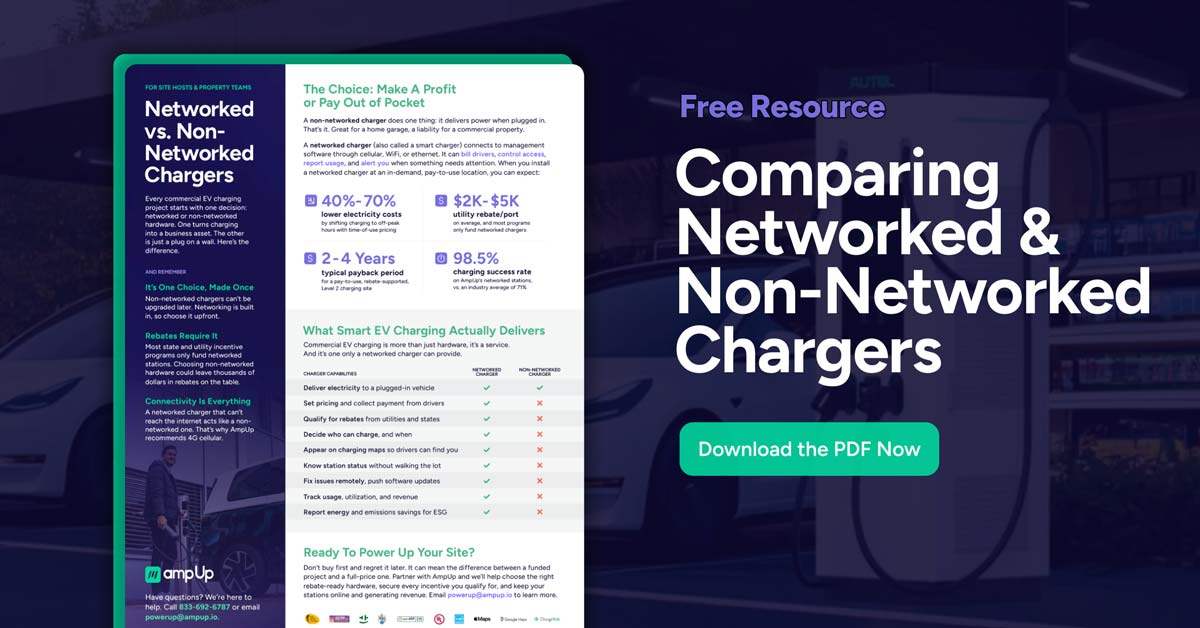
Networked vs. Non-Networked: Capability Comparison
One column does everything. The other keeps the lights on. For a commercial property, that's not a comparison, it's a checklist of everything you'd be giving up.
Why Commercial Properties Need Networked Chargers
At a workplace, multifamily building, or retail site, charging is a service you operate, not an appliance you install. Networked stations give you the tools that make the service viable:
- Cost recovery that runs itself. Set pricing by kWh, session, or time of use. Drivers pay through the app, and revenue flows back to you. No cash boxes, no honor systems, no chasing tenants for reimbursement.
- Access control you define. Open stations to the public during business hours, reserve them for tenants overnight, or offer preferential pricing to employees. You decide who charges, when, and at what rate.
- Visibility before drivers complain. Real-time status tells you when a station is occupied, available, or faulted, so problems get fixed before they cost you a tenant's goodwill.
- Reporting that satisfies everyone. Energy and usage data feeds expense allocation, ESG disclosures, and utility program requirements without manual meter reads.
- Software that stays current. Automatic updates keep stations secure and compliant as standards evolve, protecting the hardware investment for years.
There's also a factor many buyers discover too late: most utility and state incentive programs require networked chargers as a condition of funding. Programs want usage data to verify the investment, and non-networked hardware can't provide it. Choosing a non-networked station can mean leaving thousands of dollars per port on the table.
Wired, WiFi, or Cellular: How Networked Chargers Connect
Not all network connections are equal, and connectivity is where many charging programs quietly fail. A networked charger that can't reach the internet behaves exactly like a non-networked one.
- Wired (Ethernet): Rock-solid once installed, but trenching data lines to a parking lot or garage adds real cost, and the connection depends on the building's network staying up.
- WiFi: Cheap to set up and fine on paper. In practice, parking areas sit at the edge of WiFi coverage, concrete garages create dead zones, and every router change or password update at the property risks knocking stations offline.
- Cellular (4G LTE): The station carries its own connection, independent of site IT. No trenching, no dead zones from building materials, no outage because someone changed the WiFi password. Stations come online the day they're installed and stay connected.
AmpUp recommends 4G cellular connectivity for commercial deployments because it removes the single most common failure point: dependence on the site's own network infrastructure. Reliable connectivity is a big part of how AmpUp-managed stations maintain a 98.5% charging success rate, well above the roughly 71% of charging attempts that succeed industry-wide.
Managing Networked Chargers with AmpUp EV Cloud
Networked hardware is only half the equation. The management platform determines what you can actually do with all that connectivity.
AmpUp EV Cloud is hardware-agnostic, working with dozens of approved charger manufacturers over OCPP, so you can choose equipment on merit instead of being locked into one vendor's ecosystem. From a single dashboard, site hosts control pricing, access, and energy usage across every station and every location.
Inside Community Manager, AmpUp's site host portal, KlooBot uses AI-powered diagnostics to detect and resolve station issues, often before drivers ever notice. That proactive approach to EV charger management is part of how drivers on the AmpUp network have logged more than 100 million electric miles. Book a demo or schedule a site visit to take the next step on your charging journey.
Networked EV Charger FAQs
Can I convert a non-networked charger into a networked one?
Usually not. Networking capability is built into the charger's hardware, and most non-networked units have no communication module to activate. In most cases, upgrading means replacing the station, which is why choosing networked hardware upfront is the safer investment. That said, chargers stranded on a shuttered network can sometimes be re-onboarded instead of replaced — see how AmpUp keeps orphaned chargers running.
Do networked EV chargers cost more?
Networked chargers carry a higher upfront price and typically a software subscription. But they're the only option that generates revenue, qualifies for most rebates, and avoids the cost of manual management. For commercial sites, total cost of ownership favors networked stations, often decisively once incentives are counted.
Is WiFi or cellular better for EV charger connectivity?
Cellular is more reliable for commercial installations. WiFi coverage is often weak in parking areas and garages, and it depends on the property's network staying stable. A 4G cellular connection is independent of site infrastructure, which is why AmpUp recommends it for commercial deployments. More on why connectivity makes or breaks a charging program.
Do rebate programs require networked chargers?
Most do. Utility and state incentive programs typically require networked stations because they need usage data to verify the program's impact. Check your program's specific requirements, but assume a non-networked charger will disqualify you from most commercial funding.
What is OCPP and why does it matter?
OCPP (Open Charge Point Protocol) is the open standard that lets charging hardware and management software from different companies work together. Choosing OCPP-compliant hardware and an OCPP-based platform like AmpUp means you're never locked into a single vendor.
Ready to see networked charging done right? Book a demo of AmpUp EV Cloud, or send an email to sales@ampup.io.